logo
Bentley revel new 4×4 SUV concept at Geneva

Bentley revel new 4×4 SUV concept at Geneva

Bentley is offering a vision of the future with a dramatic new Sport Utility Vehicle concept, EXP 9 F, at the Geneva International Salon d’Auto. The Company’s designers and engineers have created a compelling new take on the Grand Touring Bentley – a vehicle that feels equally at home at an opera gala performance, on the sand dunes and the overtaking lane of the autobahn.

  • EXP 9 F all-wheel drive luxury Sport Utility Vehicle concept revealed at Geneva Motor Show
  • Potential for third Bentley model-line alongside Mulsanne and Continental ranges
  • Bold reinterpretation of Bentley design cues in a spacious, versatile and high performance SUV
  • A fusion of contemporary, crafted luxury, advanced in-car technology, commanding driving position and all-terrain capability
  • 6.0 litre, twin turbocharged W12 engine and 8 speed transmission

Unmistakably a Bentley – yet a Bentley like none before it – the EXP 9 F could herald a third Bentley model-line alongside the bespoke Mulsanne and the high performance Continental GT, GTC and Flying Spur.

Today a global luxury brand with a network of 160 dealers from Shanghai to Beverly Hills, Bentley has an increasingly diverse customer base spanning every continent. For many customers, a dramatically styled, Bentley all-wheel drive SUV which combines a spacious, versatile cabin and commanding driving position, with Bentley’s hallmark power, performance, advanced technology and hand crafted luxury, would be a natural choice both on and off-road.

“We are very excited by the potential of a high performance, ultra-luxury Bentley SUV. We know that many Bentley customers already own SUVs, admiring their style, luxury, performance and versatility. With EXP 9 F, Bentley is making a clear statement of intent that we have both the expertise and desire to meet and exceed their expectations.” Wolfgang Dürheimer, Chairman and Chief Executive, Bentley Motors.

BOLD, DYNAMIC, SPORTY DESIGN

  • Key Bentley styling cues re-interpreted for EXP 9 F with innovative detailing
  • Sculptured flowing surfaces emphasise power, muscularity and robustness

From a designer’s perspective, EXP 9 F was a dream project, the chance to create a completely new type of Bentley. From the very beginning, the design team had a clear vision for the new Bentley SUV, as Dirk van Braeckel, Director of Design, explains:

“EXP 9 F had to represent the absolute pinnacle of the sport utility sector, setting a new benchmark for this type of vehicle. The style had to reflect Bentley’s sporting character despite its radically different package and purpose together with sculptured, flowing surfaces in keeping with the Bentley tradition.”

A new class of Bentley allowed the styling team to adopt a more progressive design approach. The exterior is a bold, dynamic statement, combining clean, muscular surfaces with signature character lines, while retaining the qualities of luxury and power – a pure Bentley.

Key Bentley cues such as the matrix grille, round lamps and the strong power-line and haunch along each flank are reinterpreted for EXP 9 F. The ‘hewn from solid’ design language and innovative detailing, emphasise the robust character of this high-luxury SUV.


The designers were inspired not only by the more functional nature of EXP 9 F but by the ‘visible engineering’ of the famous Blower Bentleys. For example, the day-time running lamp apertures also act as the charge cooler air intakes for the twin-turbo W12 engine, each with a dramatic, mesh-covered turbine fan design and ‘rifled’ inner surface finish.

The turbine theme continues with the stunning 23-inch alloy wheels, the design of which complements the sculptured coachwork. The multiple spokes are reminiscent of the shape of turbine fan blades while the centrally mounted wheel nut is a visual reference both to Bentley’s Le Mans racers of the 1920s with centre-lock spinner and to the single nut found on the modern-day Speed 8’s high-tech racing alloys.

At the rear, the swooping lines of the tailgate avoid utilitarian overtones in favour of a distinctly sporting profile, while the ultra-wide, two-part split tailgate offers a high level of versatility when grand touring. The bold design language of EXP 9 F is complemented by twin exhaust tailpipes with ‘rifled’ inner surfaces, their elliptical shapes echoing those of the rear light clusters.

The rear lights are inspired by the forms and details of fighter jet engines, uniquely designed so that they glow from within, spreading their light outwards.

INTERIOR – A FUSION OF LUXURY WITH UTILITY

  • Light, airy, contemporary cabin design with exquisite British ‘sporting’ luxury craft detailing
  • Contemporary use of touchscreen and tailored interface technologies
  • Fresh interpretation of traditional handcrafted materials with highly durable surfaces
  • High degree of practicality including versatile rear cabin layout and full-width, two-piece tailgate

Bentley is renowned for its fusion of extremes – technology and craftsmanship, luxury and performance – and the interior of EXP 9 F expresses the resolution of apparent opposites in its use of materials, techniques and technology, as Dirk van Braeckel explains:

“The challenge for the interior design team was to create a cabin which provides a blend of luxury and utility. The result is a light and airy environment with a commanding view of the road and a versatile layout which showcases Bentley’s craft and design language in an innovative and contemporary way.”

Traditional handcrafted elements such as wood, leather and polished metals such as aluminium, bronze and gunmetal are used to create a sense of British luxury, yet the way they are used sets a fresh and contemporary interior ambience. Soft-touch leather contrasts with highly durable surfaces with the concept car design experimenting with the use of saddle leather for the seat backs, top roll and loadspace – while analogue bezels and dials are paired with TFT ‘virtual’ instrumentation.

Even the luxurious silk wool floormats are reversible – with one side finished in durable, ribbed saddle leather for use when the driver and passengers are dressed for the great outdoors.

The upright dashboard design features a full-width, one-piece wood veneer with a subtly negative surface and instruments with a configurable display. Traditional Bentley ‘bulls eye’ vents have a ‘rifled’ gunmetal inner surface for a more contemporary and functional appearance. The centre console is a blend of functionality and supreme ergonomics with dynamic, architectural layers which help to create a central spine to the cabin. The frame of the console is also a structural component with integrated, sculpted grab handles.

The flowing roof design with a panoramic glass panel is inspired by the roll cages of rally cars, expressing both strength and lightness.

Rear seat passengers can chose between business mode, with generous legroom complete with fold-down keyboard and full internet connectivity via an iPad or tablet or a more reclined position with powered footrest, drinks table and an infotainment screen for movies. When the rear seats are not in use, they can be powered forward to create a larger loadspace for sports equipment or luggage.

The EXP 9 F seating is 4+1, with a rear armrest lifting to reveal a cooled compartment for champagne and glasses. Seats feature a diamond-quilted ‘shoulder line’ in soft-touch leather, echoing the traditional appearance of a British field sport jacket.

At the rear, the lower section of the two-piece tailgate may be used as a viewing bench or picnic table. Bespoke picnic hampers are stowed neatly to either side of the loadspace when not in use, but are located on rails for easy access. An awning extends over the tailgate to protect those seated there; two umbrellas fit either side of the rear luggage area for when the rain clouds sweep in.

COMMANDING DRIVING POSITION AND CONTROL ARCHITECTURE

  • Inspired blend of traditional analogue and TFT touchscreen technology
  • Bespoke interface engineering – tailored to the individual with driver-selectable instrumentation  modes

As befits a Bentley, the EXP 9 F design concept features a near-infinite choice of driver information and entertainment options. However the design and electrical engineering teams sought to avoid creating a cluttered or confusing driver and passenger environment, presenting only the information that each user needs, when they need it.

As a result, EXP 9 F places key driver information such as 3D navigation in a central TFT panel directly in the driver’s line of sight, where it is flanked by two analogue reverse-read dials. Meanwhile controls that are shared between driver and front seat passenger, such as cabin temperature, air vents and entertainment are presented in the central touchscreen and console. The TFT screen deploys from the full-width metal trim to provide a fully integrated extension to the glass surface of the centre console

Three different driving modes – Comfort, Sport and Off-Road – are selectable according to the road environment and type of journey. Thus the driver information TFT panel would be able to switch between satellite navigation on the motorway to a ‘sump cam’ when negotiating a bumpy track.

BENTLEY POWER AND PERFORMANCE

Although the EXP 9 F concept is based around the Bentley 6.0 litre, twin-turbocharged W12 engine with an 8-speed transmission, both the company’s recently-launched 4.0 litre, twin-turbocharged V8 or a hybrid drivetrain could meet the performance requirements of a pinnacle luxury SUV.

Whilst EXP 9 F is primarily intended to investigate new design territory – and all drivetrain options remain under consideration – any Bentley SUV would offer the thunderous performance the marque is renowned for.  The W12 6.0 litre powertrain, for example, could develop 600bhp and 800 Nm of torque with key performance indicators like the top speed and 0-60mph sprint time all setting new benchmarks for the SUV sector.

EVALUATION, REFINEMENT AND FUTURE PLANNING

When the first generation Continental GT was unveiled in 2003 it represented the renaissance of Bentley as a global luxury icon, subsequent launches such as Mulsanne, Continental Flying Spur saloon and the new Continental GT have seen the Bentley brand growing from strength to strength.

EXP 9 F represents the chance to take Bentley values of design, craftsmanship and engineering excellence into what would be – literally – new terrain for the brand. Bentley’s experience with the all-wheel drive Continental range makes the concept of a Bentley SUV a natural progression for the company.

Customer and public reaction will be analysed following the unveiling of EXP 9 F at Geneva 2012, with the aim of refining the concept further. Above all, Bentley will be listening carefully to the reaction of customers and potential customers throughout the world, prior to making any definitive commitment to production.

“A Bentley Grand Tourer doesn’t necessarily have to be a coupé, a convertible or a saloon – it could equally well be an SUV. What’s important is that it should be true to Bentley’s brand values and in line with the desires and needs of our customers.”– Alasdair Stewart, Member of the Board, Sales and Marketing.

The Lamborghini Aventador J revealed

The Lamborghini Aventador J revealed

At the 2012 Geneva Motor Show, Automobili Lamborghini is presenting the most uncompromising open super sports car of its entire history. The Lamborghini Aventador J is a force of nature on wheels – supremely powerful and supremely open. The Aventador J offers its pilot and co-pilot an utterly indescribable experience of power and dynamics. At the same time, the 515 kW / 700 hp two-seater is a first class technology showcase, combining innovative solutions and brand new materials and demonstrating Automobili Lamborghini’s enormous expertise in carbon fiber technology.

The Lamborghini Aventador J is a radically open automobile – exterior and interior meld into each other. The designers and engineers in Sant’Agata Bolognese have not only dispensed entirely with the roof, but also with the front windshield. This requires that drivers of the Aventador J must have the right equipment for driving at top speeds higher than 300 Km/h.

This kind of driving at the limit is a highly exclusive experience – the Lamborghini Aventador J is fully functional for road use. It is an absolute one-off: a one-of-a-kind piece of art.

“With the Lamborghini Aventador J, we have molded our brand DNA into its most definitive form to date. This automobile is as extreme and as uncompromising as only a Lamborghini can be,” says Stephan Winkelmann, President and CEO of Automobili Lamborghini.

“The new Lamborghini Aventador J is the most radical open supersports car of Lamborghini’s history. Its name comes from our tradition and combines an unconventional design with technology innovation. Nowadays we are confronted with several regulations that we face in the spirit of challenge. The Aventador J is the proof that, despite the rules, Lamborghini will always make people dream, even in the future.”

Continuation of a glorious tradition

With the Aventador J, technically based on the Aventador, Automobili Lamborghini is carrying on its glorious brand tradition. The 1970 Jota, for instance, was the stuff of legends – a Lamborghini Miura with improved performance and virtually redesigned in every detail. It remained a one-off; although some owners subsequently had their Miuras modified to look like the Jota.

The letter J is derived from the sporting rules of the FIA world motorsport organization. Its “Appendix J” defines the technical specification of race cars in the various classes.

The Aventador: Extremely open, overwhelming power

The Lamborghini Aventador J is a super sports car of positively dramatic single-mindedness and openness. It combines the overwhelming performance of the Lamborghini Aventador with the most intense experience of power and dynamics imaginable in an automobile.

The technical basis for the Aventador J is the Aventador LP 700-4, Lamborghini’s new twelve-cylinder model. Presented in 2011, the Aventador has been acclaimed by customers and journalists alike. The Lamborghini Aventador LP 700-4’s technology package is unique – its structure is based on an innovative monocoque made from carbon fiber reinforced polymers that combines systematic lightweight design with optimum stiffness and safety. The new twelve-cylinder with a displacement of 6.5 liters and 515 kW / 700 hp combines the best in high-revving thrills with mighty pulling power. Its super-fast ISR transmission, permanent all-wheel drive and push-rod suspension combine this potent power with the utmost handling precision.

Systematic lightweight design – considerable weight reduction

Naturally, the Aventador J benefits enormously from this unique technology package. Yet the Aventador J has a significantly different interpretation to the Aventador coupé. In this open version, the monocoque has a largely new design, including the two safety bars behind the seats. The absence of a roof, of the large windshield, of the air conditioning system and of the navigation system obviously takes it to an even lower weight. With a dry weight of 1575 kilograms, the series production Aventador LP 700-4 is already extremely light for its performance class thanks to its carbon fiber construction.

Carbonskin, a brand new carbon fiber material

The unique expertise of Automobili Lamborghini in the field of carbon fiber reinforced polymers is evident not only in the hi-tech monocoque, but also in the research into further innovative solutions. Unlike traditional seats, in the Aventador J seats are made of Forged COMPOSITE®, with inserts of flexible carbon fiber fabrics: a result of an innovative Lamborghini patent.

The specialists at Lamborghini have developed an even more amazing version of carbon fiber material for the Aventador J. In its first automotive application, this carbon fiber fabric called “Carbonskin” is made of woven carbon fibers soaked with a very special epoxy resin that stabilizes the fiber structure and keeps the material soft. Like a hi-tech fabric, the carbon fiber mats fit perfectly to every shape. In the Aventador J, the complete cockpit and parts of the seats are clad in this material and shimmer in matt carbon fiber black. It’s conceivable that in future there will be many potential applications for this freshly patented and extremely fine-looking material, even very high-end clothing.

The Design: uncompromisingly Lamborghini

An extreme Aventador obviously needs an equally single-minded design, which goes without saying at the Centro Stile Lamborghini. Every single model from Sant’Agata Bolognese bears the unique design of the brand. Clear, precise surfaces, as well as sharp, often broken lines are among the unmistakable styling tools. They consistently emphasize the power and enormous presence of these Italian super sports cars. Not one line is ever accidental – the defining principle is always ‘form follows function’.

This function is very clearly defined for the Aventador J – explosive dynamics, extreme driving fun, a unique experience. Every kilometer with the Aventador J is extreme fun: something plainly evident from the very first glance.

Rear view mirror like a periscope

Virtually every part of the outer chassis was redesigned for the Aventador J, yet it shows the spirit of Lamborghini in its most concentrated form. The car’s dimensions are extreme: the overall length is 4890 mm, the overall width (excluding mirrors) is 2030 mm while the height is 1110 mm.

The highest points are marked by the rear view mirror, which is perched on an arm like a periscope, and by the two safety bars behind the seats. In place of the classic front windshield there are two small wind deflectors. The occupants of the Aventador J are confronted by the element of the wind in much the same way as a superbike rider – therefore the right clothing is prerequisite for every trip.

Front scoop with winglets

The front of the Aventador J is somewhat narrower than that of the Aventador. The front end is dominated by a highly distinctive carbon fiber air scoop, with central fixing braces and upward tilting winglets on the outer edges. Viewed from the side, the front end of the Aventador J looks like a Formula 1 racing car.

Red with chrome effect, wheels with CFRP fan

The black of the carbon fiber parts is visibly evident throughout the car – the significantly wider sill elements and the mighty rear diffuser form a perfect contrast to the rich red body paintwork. The special red color was developed specifically for this Aventador – a highly intensive red with a slight chrome effect.

The wheels, of course, were also developed specifically for this car, with 20-inch rims at the front and 21-inch at the rear. The five-spoke aluminum wheels have a central lock system and an additional carbon fiber insert that functions like a small fan for optimum brake ventilation.

Naturally, the doors on the Aventador J also open upward. They are considerably thinner than on the Aventador and are fitted with a tiny, fixed side window. The muscular flanks around the rear wheels are hallmark Lamborghini and make it immediately apparent where this particular bull keeps his power.

Rear end purely for aerodynamics and ventilation

Because of its ample dimensions, the eye is drawn inexorably to the rear end. It consists in principle of just three elements – the carbon-fiber rear diffuser, the four huge tail pipes and the rear lights with their typical Lamborghini light signature in the form of a Y. The remaining surface area is for heat dissipation and is enclosed only by a black metal mesh. The rear end is crowned by an enormous fixed spoiler mounted on the bodyshell by two arms. ‘Form follows function’ to the nth degree. The spoiler is supported by two pillars connected by the diffuser: clearly inspired by racing.

Special bumpers

In comparison with the Aventador LP 700-4, the exclusive Aventador J has special front and rear bumpers. Both bumpers have been supplemented with carbon fiber fins that act as flow deviators. Their purpose is to achieve a significant increase in the vehicle’s downforce at both the front and the rear.

The outside comes inside

The Aventador J’s exterior and interior forms flow seamlessly into each other. This supersports car turns its inside outward and is as open as it can possibly be. Conversely, the exterior ‘flows’ through the interior – a red stripe runs from the front hood, between the two wind deflectors, over the dashboard, down the console to the center tunnel and back up between the seat backs, before leaving the interior and heading for the engine cover panel.

Interior is minimalist and single-minded

This band of color connects the front and the rear of the car, creates a visual separation between the driver and passenger space and is interrupted only by a small control panel housing the starter button and the switches for lights and transmission. The Aventador J is equipped neither with a navigation nor car audio system, nor does it have the associated screen or air conditioning controls – these would simply detract from its one and only raison d’être as an extreme driving experience. What remains, of course, are two programmable TFT displays behind the steering wheel.

The engine cover also brings the inside to the outside. To be more precise, it is not so much a cover but more a framework.
This part has a new geometry (X shape) and is made of carbon fiber. Two large openings lay bare both cylinder banks of the mighty V12 power unit with its 6.5 liters of displacement – a truly stunning sight for every automobile aficionado.

A unique work of art licensed for the road

However, at the end of the Geneva Motor Show, this sight will be the preserve of just one – the future owner of the Lamborghini Aventador J. There is only one of them, no prototypes and no others for the Lamborghini Museum. The buyer can look forward to a truly unique, street-legal work of art. He will possess the most extreme expression of Lamborghini DNA in existence and a real masterpiece of high technology. But the many other fans of the super sports cars from Sant’ Agata Bolognese can rest assured – the Aventador success story has only just begun!

The Ferrari F12Berlinetta – the fastest Ferrari ever built

The Ferrari F12Berlinetta – the fastest Ferrari ever built

The first in a new generation of V12 cars has been unveiled by Ferrari.

The on-line unveiling of the F12berlinetta ushers in a new generation of Ferrari 12-cylinders in the form of a car that delivers unprecedented performance from an exceptional new engine, combined with innovative design that redefines classic themes along with extreme aerodynamics.

Revealed to the world for the first time on Ferrari.com in preparation for its official debut at the Geneva International Motor Show, the F12berlinetta, finished in an attractive new Rosso Berlinetta three-layer colour, represents the very cutting-edge of mid-front-engined sports cars.


This is, in fact, the most powerful and high-performance Ferrari road car ever launched thanks to the incredibly efficient engine – in terms of mechanical, combustion and fluid-dynamics efficiency – which, together with advanced vehicle architecture, aerodynamics, components and electronic controls, guarantee unsurpassed driving involvement whatever the road or track.

Ferrari’s traditional transaxle layout has been revolutionised to match the more extreme performance of the car. The wheelbase has been shortened and the engine, dashboard and seats have been lowered in the chassis, while the new layout of the rear suspension and gearbox enabled Ferrari’s engineers to make the rear volume of the car smaller. The overall result is a very compact car with a lower centre of gravity that is further back in the chassis, and a level of aerodynamic efficiency that sets new standards.

Scaglietti, renowned for its expertise in aluminium materials and construction, designed an all-new spaceframe chassis and bodyshell using 12 different kinds of alloys, some of which have been used here for the first time in the automotive sector, and employing new assembly and joining techniques. This has resulted in a 20 per cent increase in structural rigidity while reducing weight to just 1525 kg (70 kg less than the previous V12 coupé) with an ideal distribution between the axles (54 per cent over the rear).

The F12berlinetta’s 6262cc 65° V12 engine delivers unprecedented performance and revs for a naturally-aspirated 12-cylinder. Its maximum power output is 740 CV which translates to a specific output of 118 CV/l. Torque reaches a peak of 690 Nm, 80 per cent of which is already available at just 2,500 rpm, and which provides an unrelenting surge of acceleration all the way to the 8,700 rpm limit. The engine is mated to the F1 dual-clutch transmission, which has closer gear ratios developed specifically for this car’s performance. The F12berlinetta boasts a weight-to-power ratio of just 2.1 kg/CV .

Fuel consumption has been reduced by 30%, with CO2 emissions of just 350 g/km – figures which put the F12berlinetta at the top of the high-performance league. These results have been obtained by extensive research and development which focused on efficiencies of the whole vehicle: engine, aerodynamics, tyres and weights.

Similarly excellent results have been obtained with the car’s aerodynamic development, thanks to the integration of the design process with extensive computational fluid dynamics (CFD) simulations and lengthy testing in the wind tunnel. Downforce has been boosted by 76 per cent (123 kg at 200 km/h) while drag has been significantly reduced (the Cd is just 0.299). These results come courtesy of two new solutions. The first of these is the Aero Bridge which uses the bonnet to generate downforce by channelling air away from the upper part of the car to its flanks where it interacts with the wake from the wheel wells to decrease drag. The second is Active Brake Cooling, a system that opens guide vanes to the brake cooling ducts only at high operating temperatures, again reducing drag.

The F12berlinetta’s impressive technical specifications are completed by Ferrari’s latest generation carbon-ceramic brakes (CCM3) and the evolution of the magnetorheological suspension control system (SCM-E). As is now traditional with all Ferraris, its control systems (E-Diff, ESP Premium, F1-Trac, and high-performance ABS) are all fully integrated.

The result is that the new Prancing Horse 12-cylinder accelerates from 0-100 km/h in 3.1 seconds and from 0 to 200 km/h in 8.5 seconds. It also completes a lap of the Fiorano circuit in 1’23”, faster than any other Ferrari road car. Benchmark performance and maximum driving involvement are guaranteed by immediate turn-in, with smaller steering wheel angles, and increased cornering speed. Stopping distances have also been drastically reduced.

The design of the F12berlinetta is a result of the collaboration between the Ferrari Styling Centre and Pininfarina and is a perfect balance of uncompromising aerodynamics with harmonious proportions interpreting the typical elements of Ferrari’s front-engined V12 cars in an original and innovative way. A coupé with sleek, aggressive lines whose compact exterior dimensions conceal exceptional in-car space and comfort. The all-new Frau leather interior highlights the balance of advanced technology and sophisticated, handcrafted detailing. In the middle of the light and lean dashboard, there are new carbon fibre and aluminium air vents clearly inspired by the aeronautic field.

The cabin has been optimised to ensure maximum usability of the interior space with additional luggage capacity behind the seats, which can also be easily reached thanks to the large aperture offered by the tail-gate. With the cockpit designed around the driver, typical of all Ferraris, the Human Machine Interface approach is emphasised, grouping all the major commands within immediate reach to guarantee maximum ergonomics for the most involving driving experience.

TECHNICAL SPECIFICATIONS

Engine
Type 65-degree V12
Total displacement 6262 cc
Maximum power output 740 CV at 8250 rpm
Maximum torque 690 Nm at 6000 rpm
Dimensions and weight
Length 4618 mm
Width 1942 mm
Height 1273 mm
Dry weight* 1525 kg
Weight distribution 46% front, 58% rear
Weight-power ratio 2,1 kg/CV
Performance
Maximum speed over 340 km/h
0-100 km/h 3.1 seconds
Jaguar XF Sportbrake revealed

Jaguar XF Sportbrake revealed

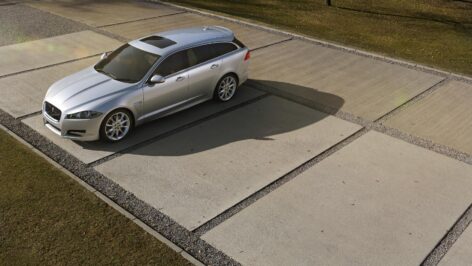
The new Jaguar XF Sportbrake has been unveiled ahead of its public debut at the Geneva Motor Show and promises to be the most versatile Jaguar ever created.

Sharing its underpinnings with the XF saloon, the Sportbrake’s overall length grows by just 5mm, its weight by less 70kg and its chassis structure matches the strength of the conventional XF. These characteristics mean the Sportbrake can closely match the acclaimed handling of the XF saloon yet offers a large and highly practical load space.

Every panel on the XF Sportbrake, from the B-Pillar rearwards, is new. The strong silver signature line running the length of the car is extended while the C-Pillar is finished in gloss black, a trait shared with the XJ saloon. Slim rear light units extend into a strong chrome crossmember that dominates the rear of the car. The result is a car that blends style and function with the rear seat occupants benefitting from 48mm of extra rear headroom.


The large, practical tailgate can be specified with power struts, opening to reveal a wide and highly versatile load space. Measuring 550-litres with the rear seats up, the boot is framed by a set of useful cubby compartments.  With the seats folded, the total volume grows to 1,675-litres.

Practical touches are prevalent – and standard equipment – on the XF Sportbrake. Remote fold levers are mounted within the boot area to lower the rear seats – negating the need to stretch into the boot. Powerful LEDs throw a pool of light onto the ground when the boot is open while the tailgate itself features a soft close function, avoiding any requirement for it to be slammed. Set into the boot floor is a panel that splits into three sections to allow smaller loads to be neatly wedged and avoiding a precious or fragile cargo being thrown about. A tray mounted under the boot floor helps protect valuable items.

Beneath the car there are extensive changes to the rear suspension. Self-levelling air suspension aids driving dynamics and means the Sportbrake can serve as an accomplished tow vehicle.

Powering the XF Sportbrake will be a range of efficient yet powerful diesel engines in 2.2-litre four cylinder and 3.0-litre six-cylinder form, each directing drive through the rear wheels via an advanced eight-speed automatic gearbox.

Prices and specifications will be announced nearer the time of the launch of the Sportbrake, set to take place in the third quarter of 2012.

Geneva Show more power and less weight for Ferrari California

Geneva Show more power and less weight for Ferrari California

 The Geneva Motor Show will see the official debut of the new updated version of the Ferrari California. This improved model is already in production and includes a reduction in weight of 30 kg and an increase in power output of 30 CV.

The Ferrari California’s GDI V8 now delivers 490 hp with maximum torque of 505 Nm at 5,000 rpm, thanks to new exhaust manifolds and engine mapping. The torque curve has also been modified and is higher across the engine’s generous rev range.


Cutting-edge aluminium fabrication techniques and construction technologies used by the Scaglietti Centre of Excellence in the manufacture of the Ferrari California’s chassis, have led to an overall reduction of 30 kg in the car’s weight without impinging in any way on its structural rigidity and performance.

These enhancements have improved the Ferrari’s California’s performance, reducing its 0-100 km/acceleration time to 3.8 seconds. This heightens its sporty feel without detracting from the mission and character of a car that has won universal acclaim for its performance and exceptional versatility resulting from its retractable hard top and 2+ seating.

To meet the needs of clients desiring a more dynamic, yet not overly extreme, driving experience, an optional Handling Speciale package has been developed which encompasses modifications to the suspension set-up that minimise body roll and make the car even more responsive to driver inputs.

The Handling Speciale package includes Magnetorheological dampers controlled by an even faster ECU (-50% response time) running patented Ferrari software. The package also features stiffer springs for more precise body control combined with a comfortable ride. Lastly, the California benefits from faster turn-in with smaller steering wheel angles thanks to a new steering box with a 10 per cent quicker steering ratio.

All these new features combine to underscore the California’s sporty prowess without affecting its high-performance grand touring vocation – an achievement very much in line with Ferrari’s DNA.

The technical features are matched by a new, even more extensive choice of colours developed by the Ferrari Styling Centre, including two-tone finishes, three-layer paint technology and modern re-interpretations of classic colour schemes which increase the  exclusive personalisation possibilities even further. In addition, the Ferrari California benefits from the free seven-year standard maintenance programme.

Skoda reveal new pictures of VisionD concept

Skoda reveal new pictures of VisionD concept

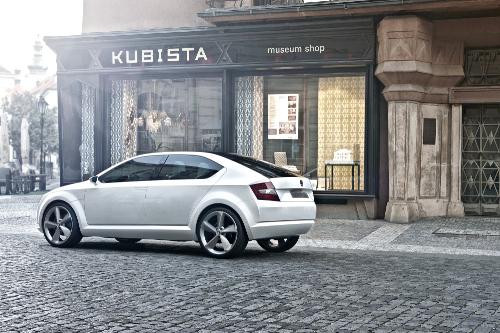
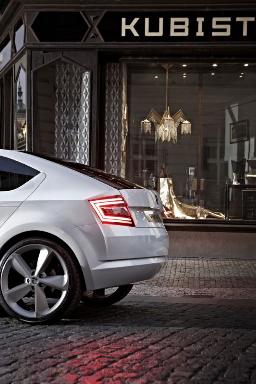
The VisionD concept from Skoda has certainly given us a glimpse of what we might expect from future models since its unveiling at the Geneva Motor Show in March.

Its sharp lines give the VisonD a tough, sporty appearance that distances it from its VW cousins.

Lets hope that this concept makes it to the road as Skoda finally seem to have found their own identity in the VisonD.